Skip to main content
Contents
Search Book
Search Results:
No results.
Embed Read aloud Readability settings Prev Up Next \(\newcommand{\N}{\mathbb N}
\newcommand{\Z}{\mathbb Z}
\newcommand{\Q}{\mathbb Q}
\newcommand{\R}{\mathbb R}
\newcommand{\st}{~:~}
\newcommand{\imp}{\rightarrow}
\def\iff{\leftrightarrow}
\newcommand{\card}[1]{\left|#1\right|}
\newcommand{\ds}{\displaystyle}
\newcommand{\lt}{<}
\newcommand{\gt}{>}
\newcommand{\amp}{&}
\definecolor{fillinmathshade}{gray}{0.9}
\newcommand{\fillinmath}[1]{\mathchoice{\colorbox{fillinmathshade}{$\displaystyle \phantom{\,#1\,}$}}{\colorbox{fillinmathshade}{$\textstyle \phantom{\,#1\,}$}}{\colorbox{fillinmathshade}{$\scriptstyle \phantom{\,#1\,}$}}{\colorbox{fillinmathshade}{$\scriptscriptstyle\phantom{\,#1\,}$}}}
\)
Worksheet Proof Styles
Decide which of the following are valid proofs of the following statement:
If
\(a b\) is an even number, then
\(a\) or
\(b\) is even.
Note: You can assume all of the algebra below is correct (because it is).
1.
Suppose \(a\) and \(b\) are odd. That is, \(a=2k+1\) and \(b=2m+1\) for some integers \(k\) and \(m\text{.}\) Then
\begin{align*}
ab \amp =(2k+1)(2m+1)\\
\amp =4km+2k+2m+1\\
\amp =2(2km+k+m)+1\text{.}
\end{align*}
2.
Assume that \(a\) or \(b\) is even - say it is \(a\) (the case where \(b\) is even will be identical). That is, \(a=2k\) for some integer \(k\text{.}\) Then
\begin{align*}
ab \amp =(2k)b\\
\amp =2(kb)\text{.}
\end{align*}
3.
Suppose that \(ab\) is even but \(a\) and \(b\) are both odd. Namely, \(ab = 2n\text{,}\) \(a=2k+1\) and \(b=2j+1\) for some integers \(n\text{,}\) \(k\text{,}\) and \(j\text{.}\) Then
\begin{align*}
2n \amp =(2k+1)(2j+1)\\
2n \amp =4kj+2k+2j+1\\
n \amp = 2kj+k+j+\frac{1}{2}\text{.}
\end{align*}
But since
\(2kj+k+j\) is an integer, this says that the integer
\(n\) is equal to a non-integer, which is impossible.
4.
Let \(ab\) be an even number, say \(ab=2n\text{,}\) and \(a\) be an odd number, say \(a=2k+1\text{.}\)
\begin{align*}
ab \amp =(2k+1)b\\
2n \amp =2kb+b\\
2n-2kb\amp =b\\
2(n-kb)\amp =b\text{.}
\end{align*}
Therefore
\(b\) must be even.
Sudoku Proofs.
A
\(4\times 4\) sudoku puzzle is
valid provided no number 1 to 4 repeats in any row, any column, or any of the
\(2\times 2\) boxes. A
solution to a puzzle is a valid puzzle that agrees with the original puzzle. A puzzle is
solvable provided there is exactly one solution.
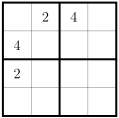
5. Consider the following sudoku puzzle.
Prove that for any solution, if the solution has a 1 in the top-right square (r1c4) then it will contain a 1 in the bottom-left square (r4c1).
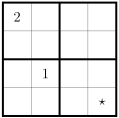
6. Consider the following sudoku puzzle.
Prove that if the sudoku puzzle has a solution, then the bottom-right corner (r4c4) cannot be a 2.
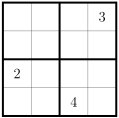
7. Prove that any solution to the sudoku puzzle below must have a 4 in the top-left corner (r1c1).