Section Syllabus
Welcome to what promises to be an exciting and fun semester of Discrete Mathematics! I know you are all eager to get started, but please take a few moments to familiarize yourself with this syllabus.
Subsection Course Information
This is the syllabus for Discrete Mathematics (MATH 228, section 004) for Fall 2026. It is a 3 credit course.
- Instructor
-
Oscar Levin, Ross Hall 2240D, [email protected].
- Student Hours
-
TBD. Other times by appointment.Important: I want to see you in student hours, and will happily make appointments with you outside of the regular hours. I’m also available by email and will respond within 24 hours, usually much sooner. There is little I enjoy more than discussing mathematics, so you are really doing me a favor by coming to see me.
- Class meets
-
Mon/Wed/Fri 11:15-12:05 in Ross 2060.
- Course Description
-
A survey course of non-calculus based mathematics used extensively in computer science and other disciplines. Study sets, types of proofs, logic, recursion and related topics.
- Prerequisite
-
None.
- Textbook and Course Materials
-
Discrete Mathematics: an Open Introduction, by Oscar Levin, 4th ed. Free interactive online ebook on Runestone (see link in Canvas).
Course Overview.
Discrete mathematics studies finite sets. In many ways, this makes the content much easier to understand than continuous mathematics with its infinitely many points, arbitrarily close or large numbers... all the stuff of calculus. And yet, while we will “just” be doing things like counting how many things there are in a set, we will see that the subject leads to beautiful and complex structures of mathematics.
Some of the topics we will explore include,
-
Discrete structures: sets, sequences, functions, relations, and types of graphs.
-
Logic: truth-tables, valid arguments, converse and contrapositive, quantifiers, proofs.
-
Graph Theory: colorings, trees, planar graphs, Euler trails and Hamilton paths.
-
Combinatorics: sum and product rule, binomial coefficients, combinations and permutations, principle of inclusion/exclusion, modeling counting problems with discrete structures.
-
Sequences and Recursions: recursive and closed formulas for sequences, solving recurrence relations, modeling problems with sequences.
-
Mathematical induction and recursive reasoning.
In class we will be actively exploring discrete math by doing problems. It is important that you work together with your group members. You will most likely find this course very different from previous math courses. Instead of memorizing formulas and procedures, we will spend our time investigating patterns and solving problems. Further, getting an answer will rarely be enough for us; we will need to give good reasons that the answers are correct. To give these “proofs” of our answers, there will be a fair amount of writing in this course.
Learning Targets and Core Competencies.
While we will learn to do more than just the following tasks, these are the key learning targets for the course, organized into four categories.
Logic and Proof.
-
I can use truth tables to determine the logical relationships between statements.
-
I can prove simple mathematical statements using direct, contrapositive, and contradiction proofs.
-
I can interpret implications and quantifiers to inform my mathematical reasoning.
-
I can apply proof techniques and definitions to prove facts about various discrete structures.
Graphs and Relations.
-
I can model real-world questions with graphs and identify how the properties of the graph relate to the real-world question.
-
I can prove basic facts about graphs and trees.
-
I can apply theorems about graphs to solve problems and prove properties.
-
I can identify properties of relations and prove that relations have these properties.
Counting.
-
I can distinguish between combinations and permutations and explain the relationship between them.
-
I can use discrete structures to represent counting outcomes so the appropriate counting techniques can be applied to solve the problem.
-
I can solve counting problems combining multiple counting techniques.
-
I can use combinatorial proofs to establish identities.
Sequences and Recursion.
-
I can model problems using sequences and their recurrence relations.
-
I can explain the relationship between recursive and closed formulas, and use this to identify various classes of sequences.
-
I can solve recurrence relations using appropriate techniques.
-
I can prove statements by mathematical induction.
Core Competencies.
-
I can use logic and mathematical proofs to establish explain why statements are true or false.
-
I can use discrete structures, including graphs, to model real-worlds problems and explain how the properties of the discrete structure relate to the real-world problem.
-
I can demonstrate how counting techniques can be used to enumerate the number of outcomes in a real-world problem.
-
I can apply recursive reasoning to solve problems and explain how the recursive solution leads to a general solution.
Subsection Assessments and Grades
The goal of this course is to understand the fundamental concepts of discrete mathematics. Measuring understanding is a difficult task. How can you (and I, since I’m assigning you a grade) be confident that you understand?
I don’t have a perfect answer, but what we will use in this course is a combination of two types of indirect evidence.
-
You can accomplish a variety of tasks that someone with a good understanding of discrete mathematics should be able to accomplish. We will divide these tasks into 16 learning targets, listed above, and throughout the course you will have opportunities to demonstrate your mastery and expertise of these learning targets.
-
You engage meaningfully in mathematical practice, doing the mathematics that leads to understanding. This includes participating in discussions, exploring new ideas, trying hard things (often unsuccessfully at first), revising your work, and asking good questions.
Regardless of your level of understanding entering this course, my hope is that you will leave with an improved understanding of mathematics. One of my favorite things about mathematics is that no matter how much you understand, there are still more fascinating connections to discover.
Final Grades.
By the end of the course, you will have demonstrated Mastery (M) on a number of the 20 learning targets. You will also have earned an engagement score based on your performance of a variety of work in and out of class.
Your final grade in the course will be determined by these two factors, according to the following table.
| A | B | C | D | |
|---|---|---|---|---|
| Mastered Learning Targets | 19 | 16 | 13 | 11 |
| Engagement Score | 90% | 80% | 70% | 60% |
To receive a particular grade, you must meet or exceed the requirements for that grade in both categories. If you do not meet the requirements for a “D”, your final grade will be an “F.”
It is also possible to receive a plus or minus grade if your engagement score is one level above or below the level of your learning target mastery score. See the following two-way table for the details.
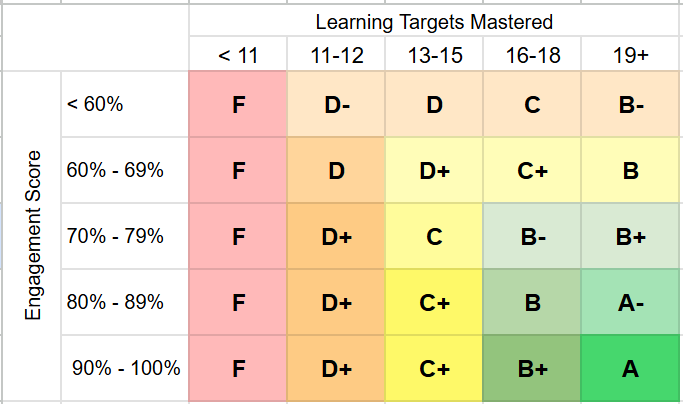
I reserve the right to modify the above rules, but will only do so in a way that results in higher grades for students.
Assessment of learning targets: Exams.
Learning targets will be assessed on four in-class exams, each covering four learning targets. The four core competencies will be assessed on the final exam. Dates for the exams are listed below (but subject to change).
1
In the unlikely event that the University is closed due to inclement weather on the day of our exam, we will hold the exam at the same time on Friday, Decemnber 11 (the designated makeup day for this situation). In the event that this makeup day is also canceled, I will contact you with alternative options.
| Assessment | Learning Targets | Date |
|---|---|---|
| Exam 1 | LP 1-4 | Monday, 9/21 |
| Exam 2 | GR 1-4 | Monday, 10/12 |
| Exam 3 | C 1-4 | Monday, 11/2 |
| Exam 4 | SR 1-4 | Monday, 11/23 |
| Final Exam | CC 1-4 | Wednesday, 12/9 at 10:45 |
Each question on an exam will be clearly aligned with one of the learning targets. If you demonstrate mastery on a target, you will receive a grade of M on it and you can count that to your learning targets mastered total.
Learning targets on which you do not demonstrate mastery will receive a grade of N (Not yet), P (Partial understanding), or R (Revise). These do not count toward anything, but indicate how close you are to getting mastery on the target.
Since learning is a process of improvement, after each exam you may reattempt to demonstrate your understanding of any learning targets you have not yet mastered. This will be done by completing a learning target quiz outside of class during student hours (either the regularly scheduled ones or by appointment). The only exception is that if you received a grade R on a target, you may be able to skip taking a separate quiz by explaining your reasoning and mistake to me in person.
If you successfully demonstrate mastery on a learning target quiz, it counts fully as an M toward your total. If not, additional attempts are possible, but only after meeting with me to make a plan to improve your understanding of the target.
Retakes and revisions to learning targets must be completed prior to the next exam.
Assessment of Mathematical Engagement: Participation and Homework.
Your level of effort and engagement will be assessed through your participation in class and completion of a variety of homework assignments. Each of the following categories will contribute equally to your Engagement Score.
- Participation
-
I expect you to attend every class and participate actively when present. This includes asking questions, contributing to discussions, and collaborating with your peers. Every two weeks you will complete a very short online self-assessment to report your level of participation in and out of class, which I will use to assign you a score for participation.
- Prep and Practice
-
You are expected to read each section of the textbook as assigned on Canvas, and respond to the interactive prompts while reading. At the end of each section, there are also a number of online practice problems, for which you can get instant feedback. All the book assignments will be listed on Canvas and must be completed in Runestone.
- Written Homework
-
In addition to the practice problems in the textbook, you will be asked to answer more involved questions in writing. Sometimes this will be a single question that you should solve for the next class; other times it will be a small homework set that will be due a few days after we finish working on the corresponding material in class. You should expect to write out solutions and your reasoning in full sentences: writing about mathematics is one of the best ways to further your understanding of mathematics. You are encouraged to work together on the homework, but you must write up your own solutions in your own words. You will submit your homework assignments on Canvas.
- Group Project
-
You will have an opportunity to explore an application of discrete mathematics to your major or other interests. In a small group, you will explore a real-world problem and the ways discrete mathematics can help solve it. The project will result in a short paper and in-class presentation. More details about the project will be provided later.
Note about Grades in Canvas.
All your grades for all assignments will be kept inside Canvas, so you can always check to see how you are doing in this class.
However, note that your final grade depends on two measures: learning target mastery and your engagement score. There is no good way to show this inside Canvas, so make sure you are applying the rules above to your grades to determine your projected final grade.
Subsection Course Policies
Attendance.
Attendance is expected and critical to your success, and you will be missed if you are absent. Showing up is a key to success in all aspects of life. At the same time, I realize that it may be necessary for you to miss some class meetings due to work, family commitments, and so forth. In that case, let me know of your absence, and we can come up with a plan to help you stay up-to-date.
One important note though: in this class, just like in every other class, missing a day of class, even with a perfectly valid excuse, does not excuse you from learning what was covered that day. As your instructor, I will try to help you catch up, but this will take more work than it would have if you were in class.
Late work.
All assignments have due dates; these exist to help you manage your workload and help me manage getting you feedback in a timely manner. To help motivate you to keep these deadlines, turning in your work on or before the due date will have the following benefits:
-
You will be among the first students to receive feedback/grades on the assignment.
-
Opportunity to revise submitted work for a better grade.
-
Less stress about upcoming work and easier/better learning for the next topic in class.
Additionally, most assignments will have an absolute cut-off for late work one week after the official due date. This is intended to give you a little flexibility but also not let old work pile up on top of you; sometimes it is just better to start with a clean slate and dive into the next thing.
Of course, life can happen and you don’t owe me an explanation for why you might occasionally miss a deadline. Just let me know if you will be handing in something late and when I can expect it. This should not occur regularly; if you are having trouble meeting deadlines consistently, let’s chat and make a plan.
Classroom Decorum.
Please be respectful of your and my time by staying off your cell phones when in class, arriving on time, and not packing up your things before the end of class.
Additionally, we expect that you will treat all members of our course community with respect and kindness. In doing mathematics, or almost anything worth doing in life, you are going to make many errors and false starts while becoming more proficient. Think, for example, of learning to play a musical instrument, or learning an athletic skill, or developing a friendship. We want to establish a classroom atmosphere where the inevitable struggles and mistakes become an opportunity to learn and grow; not an opportunity for embarrassment. Thus, please be constructive and polite in questioning your colleagues in class.
Academic Integrity.
Don’t cheat! It is expected that members of this class will observe strict policies of academic honesty in every aspect of this course. In particular, you are expected to solve homework problems by yourself or together with your group, and not find solutions online. In general, UNC’s policies and recommendations for academic misconduct will be followed. For additional information, please see the Student Code of Conduct at the Dean of Student’s website http://www.unco.edu/dos/Conduct/codeofconduct.html.
Generative AI.
You may use generative AI tools (such as ChatGPT, Google Gemini, or CoPilot) to help you learn, but not to shortcut the learning process. It is your responsibility to ensure that you use of these tools with academic integrity.
What does this mean? Ask yourself what you hope to get out of this course. I really hope your answer involves learning new skills, becoming a better thinker, and understanding mathematics at a deeper level (even if these goals are in service to eventually getting a better paying and more fulfilling job).
AI tools might be able to help you achieve these goals. Here are a few example prompts that you might find useful and are completely inline with these goals.
-
“I am trying to learn the concept . Give me a sample question and ask me to find the answer and explain how I found it to you. Then ask me some followup questions, acting like a student I am tutoring on the topic. Make sure I can explain everything sufficiently so you can understand the concepts involved.”
-
“My professor gave me this sample quiz question: . Generate 5 additional questions that are similar in style and difficulty and ask me to give you the answers. Don’t give me solutions until I have done so, but point out any errors I might have made.”
-
“Here is an example from my textbook: . Make up a similar question and walk me through a solution step my step, asking me to ask questions after each step to make sure I really understand the process.”
Warning: As good as AI has become recently, it is still not great at mathematics, so anything you get out of a generative AI tool should be approached with a fair amount of skepticism. This is also a good way to learn mathematics though: play “find the mistake” in what AI gives you!
To be clear, you should NOT use AI tools to shortcut the learning process. Getting someone else to do your work for you (even if that someone is a robot) is plagiarism and a violation of the academic integrity policy. If you have any doubt about whether you are using AI productively, I’d love to have a conversation about it with you.
Title IX and Equal Opportunity.
The University of Northern Colorado is committed to providing a safe and inclusive learning environment for all students that is free from discrimination and harassment, including sexual harassment, sexual assault, domestic violence, dating violence, and stalking. Students who have experienced (or who know someone who has experienced) any of these concerns should know that they are not alone. UNC has staff members in the University’s Office of Institutional Equity and Compliance (OIEC) who are trained to support students in navigating these concerns and are able to provide on- and off-campus resources and supports, referrals to health and counseling services, academic and housing modifications, and mutual no-contact orders between individuals.
Please be aware all UNC instructors and most staff members are required to report their awareness of sexual misconduct to the OIEC. This means that if students tell an instructor about a situation involving sexual harassment, sexual assault, dating violence, domestic violence, or stalking, the instructor must share that information with the Title IX Coordinator and Equity Officer, Jimmy Kohles. Mr. Kohles or a trained staff member in OIEC will contact the reporting students to let them know about resources and support services at UNC as well as their options to pursue an investigation through OIEC, law enforcement, or both. Students who have experienced these types of incidents are not required to speak with OIEC staff regarding the incident. Students’ participation in OIEC processes are entirely voluntary.
If students do not want the Title IX Coordinator notified, instead of disclosing this information to the instructor, students can speak confidentially with the following people on campus and in the community. They can connect you with support services and help explore options now, or in the future. UNC has confidential victim advocates available 24/7 by phone - students can contact the Assault Survivors Advocacy Program (ASAP) at 970-351-1490 to seek confidential guidance and support.
Subsection Suggestions for Success
First and foremost: I want you to succeed. I am here to help you learn and grow as a mathematician. I also know that this isn’t always easy. Here are a few things to keep in mind when you are feeling stuck or overwhelmed.
-
Ask questions.
Perhaps the single most important skill you can learn is how to ask questions. Think of question-asking not so much as a way to get answers, but as a way to clarify your thinking.
-
Ask for help.
Don’t hesitate to reach out for help when you need it. Whether it’s from me, your classmates, or other resources, there are many opportunities for support. I have regular student hours and am happy to schedule additional time as well.You can also take advantage of the Math Study Center in Ross 1250 for drop-in tutoring; all faculty in the department have at least one hour a week available in the center.
-
Embrace the struggle.
Learning mathematics can be challenging, but that is exactly what makes it so valuable. You wouldn’t go to the gym and lift 1lb weights every day and expect massive gains (as the kids say). Instead, you need to push yourself, take on more challenging problems, and be willing to struggle a bit in order to grow.
-
Help each other learn.
Collaboration is key to success in mathematics. Work together with your classmates, share your insights, and learn from one another. Teaching a concept to someone else is often the best way to solidify your own understanding.
I also want to acknowledge that there are often external factors that can impact your opportunity to learn. Below are some resources offered through UNC that may be helpful.
Disability Resources.
My goal is to co-create a learning space that is inclusive and responsive to your access needs. If you anticipate or experience barriers to full participation in this course for any reason, please connect with me. Whether it’s related to course design, content delivery, or materials, I welcome that dialogue.
If you are connected with the Disability Resource Center (DRC), please share your accommodation letter early so we can plan together.
If you are not yet connected but would like to explore accommodations or access resources, you can contact the Disability Resource Center: 970-351-2289, [email protected], Michener L-80, www.unco.edu/disability-resource-center.
Food Insecurity, Housing Insecurity, and Other Essential Needs.
Significant numbers of UNC students are challenged in getting enough food to eat. Others have difficulty finding safe and stable housing or meeting other essential needs, such as medical and mental healthcare, childcare and transportation. Still others face financial crises in the wake of unexpected emergencies.
Through its Center for Student Well-Being (CSW, located on the lower floor of the UC), UNC offers personalized 1-on-1 assistance to students facing food insecurity, housing insecurity, financial emergencies or other basic needs challenges. UNC also provides students with access to several food resource programs on campus, including the Bear Pantry, where students can access food and hygiene items at no cost. Resource navigators in the CSW can also help students gain access to the Supplemental Nutrition Assistance Program (SNAP) and other resources.
Student Well-being.
If you’re not sure where to turn, the website for UNC’s Student Outreach and Case Management office lists a wide variety of resources for students. Case Managers can assist students during difficult circumstances which may include medical, mental health, personal or family crisis, and illness or injury.
Mental health professionals are available on-campus and in the community. See a wide variety of on- and off-campus resources on the Dean of Student’s webpage.
For free, confidential consultations, check out the Counseling Center. To access staff in the Counseling Center, call 970-351-2496 or stop by the Center, located on the second floor of Cassidy Hall.
If you or someone else is experiencing a crisis or suicidal thoughts and the Counseling Center is not available (including evenings, weekends, and holidays), contact either North Range Behavioral Health by calling 844-493-TALK (8255) or text TALK to 38255 or the 988 Suicide and Crisis Lifeline at 988.

