
Worksheet Reasoning with the FTC

You have just bought a new space heater to warm up your dorm room. It has a two-stage heating mechanism that includes heating elements and a fan to blow the air around.
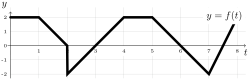
Let \(F(t)\) be the temperature in your room (in degrees Fahrenheit) \(t\) hours after midnight on Tuesday, December 2nd. While you don’t know much about \(F(t)\text{,}\) you have determined that the rate of change in temperature looks approximately like the graph shown below. Let \(f(t)\) be the rate at which temperature is changing (in degrees Fahrenheit per hour) \(t\) hours after midnight on the same day.
a piecewise linear function showing the rate of change in temperature

1.

What happens at 2am? What happens to the temperature between 2am and 3am?

2.

When is the temperature of the room getting colder? When is it warming up? How do you know?

3.

How does the temperature of the room at 3am compare to the temperature at 6am?
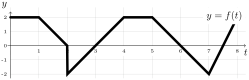
Here is the graph again, for reference:
a piecewise linear function showing the rate of change in temperature

4.

When is your room the coldest? When is your room the warmest? That is, when are the local maximums and minimums of \(F(t)\text{?}\)

5.

Suppose your friend with a nifty digital watch that has a thermometer built in drops by at 3am and notes that the temperature was \(67^\circ\text{.}\) Find the exact temperature of your room at 4am.
6.

Use the Fundamental Theorem of Calculus to find the exact temperature of the fridge at each hour mark. Fill in the table below.
\(t\) 0 1 2 3 4 5 6 7 8
\(F(t)\)
\begin{equation*} \qquad \end{equation*}
\(\qquad\) \(\qquad\) Β Β 67Β Β  \(\qquad\) \(\qquad\) \(\qquad\) \(\qquad\) \(\qquad\)

